Showing posts with label structures. Show all posts

Wednesday, November 27, 2013

SEISMIC HAZARD ANALYSIS FOR SEISMIC DESIGN IN INDONESIA

-Dr. Rusnardi Rahamat Putra
Assistant Professor, Padang state University
Padang, Indonesia.

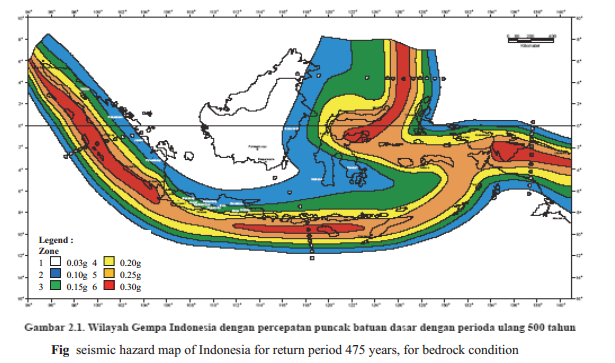
The Indonesian archipelago is located at the boundary of three major tectonic plates, the Indo-Australian, Pacific, and Eurasian plates, stretching from Sumatra in the west to Papua in the east. Indonesia is at the collision point of these three crustal plates. The high subduction-related seismicity in this region means that tsunami and other earthquake hazards are also high. Indonesia has approximately 17,504 islands, with a total land area of 1.92×10⁶   km2 and a sea area of 3.26×10⁶ km2. It has experienced a large number of earthquakes in the past. According to catalogued events, the number of earthquakes that have occurred in this region exceeds 45,778 with a magnitude greater than 4.0 from AD 1779 to 2010.
Most of the major historical earthquakes in Indonesia have caused significant damage to facilities (e.g., Utsu et al., 1992; Fauzi et al., 1999; EERI, 2010). Many large earthquakes have occurred in the shallow seas of the area that can produce massive tsunami like the 2004 Banda Aceh event. This earthquake off the coast of Sumatra resulted in hundreds of thousands of deaths and a million people homeless (Ghobarah. A et al., 2006). Tectonic and plate boundaries, Large arrows indicate the direction of plate motion.

Tuesday, August 13, 2013

How bullets are loading on earthquake gun in developing countries??

When earthquake of level around M6.5 occur in Japan hardly claim life but if the same level will be in Indonesia, Philippines, India, Myanmar, Nepal, Pakistan, Afghanistan etc. countries will have to loss in several thousands? Bryan Walsh wrote in TIME as earthquakes are gun and structures are bullet that load on gun and fire to people. He specially focus on south central Asia about earthquake and disaster in his last article How Shoddily Constructed Buildings Become Weapons of Mass Destruction . I totally agree with his article that main problem developing countries are not focused on implementation of seismic design and building codes to public during their private building constructions, hardly they follow for just civic buildings.
Most of the structures in rural areas are still stone masonry in mud mortar, during rainy season even they are more vulnerable to collapse with wetting of mud mortar, even they are as like the stack of stones so they cant hold more tremor intensity and fall down as blow on head. Rural area people must have to aware about seismic risk and its mitigation during construction of their house, with just a small additional amount (about 10%) investment on their house they can get more safer (about double ) building. Rural settlements are also catering more population in developing countries even up to now.

Monday, July 29, 2013

1980 M6.6 Earthquake of Western Nepal.


Today July 29, in 1980 western Nepal faced the tremor of M6.6 which took away about 150 lives and left injured nearly 1000 people. Estimated economic loss of that earthquake was ($245 milion!). Nepalese media and people may forget it but they have to remember those events and prepare for next event like this or even more devastating one in near future. Here is a short view on history of earthquake.
Location of 1980 earthquake

Nepal lies on seismic zone, it rests on the boundary of eurasian plate and indian plate with major faults parallel to its length. There are many fault activities responsible for ground tremors, some of them claim casualties but most of them are weak in their power. Nepal has the history of earthquake from 1255 AD when it was assumed that, 1/3 to 1/4th population got death due to earthquake about X in MM scale in Kathmandu, capital of Nepal.

Sunday, July 28, 2013

About Seismic Design Code in Nepal

(This is the part of paper that published on NEA 13th Convention technical journal in Kathmandu.)

ABSTRACT: This paper focus on study of worldwide changes in seismic design codes after large earthquakes especially in design ground motion. Kathmandu is moving towards one of mega cities in Asia, so for urban development in future we have to consider all perspectives of design methodologies to have resilient city not only Kathmandu but also all other major cities. High rise buildings and major lifeline structures within city and gateway to cities are very important to be safe. Design methodologies are major factors of control for the disaster resilient structures alongside with regulation during construction. Here we discuss about consideration of phase for design ground motion for safer structural design. 


Key Words: Urban development, seismic design, phase spectra, design ground motion

INTRODUCTION

Saturday, July 27, 2013

Bridge failure during earthquake and it's mitigation

Major type of Failures

Lifeline structures are those which are directly related to the facilities for existence of society. Nowadays many cities are facing problem to maintain the lifeline structures after the earthquake event. These structures are very important and have to be safe.
There are many lifeline structures among them bridge is also a very important lifeline structure that provide commuting and also transportation of foods, oils, water etc. History of bridge failure starts before 1907 when Qbec bridge fail. There are many failure modes of bridge, main two types of them are:

Photo: collapse of cypress street viaduct (http://pubs.usgs.gov/dds/dds-29/web_pages/oakland.html)

Shear Failure: